Who May Change the Learning Place? A Community-Governed Trial of Cultural Authority, School Belonging and Disciplinary Transfer
Dr. Freedom Cheteni · Human author
Journal for School Superintendents · The Research University · Edition 1.0 · Prepared 2026-10-16
4,635 words · 22 min · Volume 1 · 2026
Research protocol and reproducible methods. Human authorship, research permissions and editorial decisions have separate records.
This Paper Agent searches the full manuscript and returns unchanged passages linked to their sections. It does not generate conclusions, assess research quality or complete peer review.
In this paper · sections, evidence and references
Contribution
A community-governed assignment contrast with genuine refusal/private routes, longitudinal belonging and blinded transfer, supported by an executed CCD feasibility audit and retention/spillover design sensitivity.
Prospective paired-school primary trial; completed administrative source audit and artificial-data design calculations; no trial observations or causal effects reported.
Keywords: cultural authority · school belonging · community governance · disciplinary transfer · NCES Common Core of Data · cluster randomized trial · Movement Thinking
Conceptual foundation
Belonging by Design: Cultural Authority, Spatial Learning and the Work of School Leadership →Prospective primary-study design
- Planned schools
- 64
- Matched pairs
- 32
- Planned baseline students
- 2,560
- Study and follow-up weeks
- 24 + 12
The primary study is prospective. Completed methods analyses: Official NCES CCD 2023–24 version 1a school-directory and membership streaming audits; 12 paired-school retention/comparison-exposure scenarios, 10,000 artificial replicates each. Primary participant trial outcomes are not reported.
Abstract
Belonging is often pursued through visible cultural representation while decisions about what a representation means remain institutionally closed. This article specifies an original primary-study protocol testing whether consequential community authority over learning designs improves school belonging and disciplinary transfer beyond an equally resourced curriculum programme. The proposed study recruits 64 schools into 32 matched pairs, with 40 students per baseline cohort. Schools receive either a community-governed design process or an active comparison with equivalent planning time, resources, accessibility support and facilitator contact. The intervention distributes bounded rights to challenge representations, require reasoned responses and refuse disclosure or reuse; it does not prescribe an authentic culture or require public personal narratives. The primary endpoint is 24-week change in a permission-cleared school-membership measure. Blinded disciplinary-transfer tasks and a delayed assessment test whether relational gains accompany learning rather than ceremonial participation. Completed methodological investigations audit the NCES Common Core of Data school-directory and membership files and simulate paired-school designs under heterogeneous retention and comparison exposure. The directory audit identifies 102,274 unique schools and 29,115 candidates under declared grade and status restrictions. These historical administrative records support sampling feasibility, not cultural identification or proof of belonging. The article supplies governance instruments, analysis specifications, disclosure safeguards and explicit limits on measurement and causal inference. No participants have been enrolled and no intervention effect is reported.
1. From cultural visibility to a contestable learning place
A student can recognize a street, language or family practice in a lesson and still have no standing to correct its interpretation. Conversely, an unfamiliar setting can become educationally accessible when the task explains its assumptions and permits a reasoned challenge. The leadership problem is therefore not exhausted by counting culturally recognizable images. It concerns whether people affected by a representation can question it, obtain a substantive response and influence its future use.
The companion conceptual article, Belonging by Design, distinguishes representational access, interpretive authority and institutional responsiveness. The present protocol makes that distinction experimentally inspectable. It develops Cheteni’s concern with learning connected to purpose and place [1], while recognizing the intellectual priority of culturally relevant pedagogy rather than renaming its established concerns [2]. The proposed contribution is a bounded governance contrast and a prospective evidentiary design, not a claim to have invented cultural relevance.
Brown and colleagues’ culturally relevant virtual-reality science study motivates attention to the relationship between a learning setting and students’ experiences [3]. Its scope does not establish that a participatory governance package causes belonging or transfer across schools. That gap matters. A polished environment might improve enthusiasm while leaving knowledge, decision rights and institutional responsiveness unchanged. The study asks whether a different distribution of authority changes outcomes that cannot be satisfied merely by producing an attractive scene.
2. A mechanism that can fail
The intervention theory has three distinct links. First, accessible representations and meaningful choices may reduce the effort required to enter a disciplinary problem. Second, a credible right to question how people or places are portrayed may alter whether students experience their interpretations as consequential. Third, documented institutional responses may make participation trustworthy over time. These are hypothesized mechanisms, not interchangeable indicators of success.
The principal causal contrast is between two funded approaches to the same curricular objectives. Both include competent teaching, technical support and opportunities to ask questions. The treatment additionally grants defined decision rights over representations and their reuse. If it improves survey ratings but not the independently scored transfer tasks, the claim that cultural authority strengthens disciplinary reasoning remains unsupported. If participants report more meetings and less influence, the governance mechanism itself has failed.
The protocol also admits an adverse pathway. Consultation can concentrate influence among confident adults, expose students to unwanted identity expectations, or create an obligation to perform cultural authenticity. Community authority is not automatically liberating. Its implementation must therefore be judged partly by whether individuals retain usable refusal and private pathways, including against preferences expressed by a school-appointed panel. An average gain cannot justify foreseeable coercion or the unauthorized circulation of cultural knowledge.
3. Community governance before allocation
Before recruitment, each participating school develops a governance agreement with affected students, families, educators and relevant community rights-holders. The agreement distinguishes individual consent, school curriculum responsibility and collective authority over particular knowledge or representations. A parent council, a principal or one invited contributor cannot authorize everyone else’s stories. Where Indigenous knowledge or cultural material is involved, the relevant rights-holders determine who can give permission; researchers do not infer this authority from enrollment categories.
The CARE Principles locate collective benefit, authority to control, responsibility and ethics within Indigenous data governance [5]. They inform the questions that agreements must answer, without granting this study a generic license to collect Indigenous knowledge or claiming that one community’s arrangements transfer to another. Participatory research also requires attention to how roles, resources and disagreements shape the production of knowledge [6]. Recruitment cannot begin on the assumption that an invitation establishes an equitable partnership.
An independent safeguarding and ethics determination is required before the proposed trial starts. No approval number, sponsor commitment or community endorsement has been obtained in this package. The public protocol records that absence plainly. The actual decision charters, compensation arrangements and material-specific permissions must be settled locally and logged before assignment. Schools unable to establish these conditions do not enter the trial simply because the administrative database contains their identifier.
4. Questions, estimands and boundaries
The primary question is whether an offer of community-governed learning design improves school belonging over 24 weeks relative to an equally resourced comparison. Let each school’s outcome be the mean change in a fixed baseline student cohort. Within each pair, the assigned-treatment school’s mean change is contrasted with its assigned-comparison school’s change. The primary estimand averages these differences equally across participating pairs, thereby weighting schools equally rather than allowing larger cohorts to dominate.
The proposed primary measure is Goodenow’s Psychological Sense of School Membership instrument [4], contingent on permission clearance and a separate measurement pilot. It is not a measure of cultural authenticity, agreement with school policy or approval of the journal. The instrument’s established history does not guarantee that its wording, translations or longitudinal comparisons function equivalently in the proposed settings. The trial specification must be amended before allocation if the pilot identifies a materially different primary instrument or scoring rule.
Secondary questions concern blinded disciplinary transfer, durability at week 36, agency in contesting representations and the human burden of participation. Qualitative inquiry asks whose challenges receive responses and whose contributions remain absent. These analyses explain and test boundaries; they do not turn a package-level assignment into randomization of belonging, identity or community authority itself. The study does not estimate future earnings, lifelong inclusion or the effects of technology adoption in general.
5. Sampling from an administrative frame
The NCES Common Core of Data supplies school and local education agency identifiers, administrative status, grades offered and long-form membership cells [7][8][9]. These are useful starting points for reproducible recruitment, because they make the frame and exclusions inspectable. They are not a roster of cultural communities. Race and ethnicity classifications used for federal reporting must never become a classifier of the culture a student supposedly possesses or the material that student should be asked to contribute.
The candidate design is 64 regular public schools serving both seventh and eighth grades, organized into 32 pairs. Each school contributes a baseline cohort of 40 consenting students, with a target of 20 per grade when the eligible roster permits. These are planning quantities: 2,560 planned students, not people enrolled or observed. Updated enrollment, accessibility, staffing and governance agreements will determine actual eligibility. Any deviation in cohort composition requires a recorded amendment before assignment.
Matching is conducted within an LEA where feasible, using grade span, baseline cohort belonging, enrollment size and available contextual variables selected before outcomes are examined. A school appears in one pair only. Administrative characteristics support balance and feasibility rather than cultural matching. If recruiting two schools within an LEA would create unavoidable sharing of the entire governance intervention, the study must revise its assignment unit and recalculate power before allocation rather than silently treating a connected network as independent schools.
6. Completed directory-file feasibility audit
The executed audit downloaded the official 2023–24 version 1a school-directory ZIP, preserved its SHA-256 hash and streamed its CSV without converting identifiers to numbers. It found 102,274 rows and 102,274 distinct NCESSCH values. Each audited school identifier had 12 numeric characters and each LEAID had seven. No duplicate school identifier or blank value in the seven required fields was detected. These observations concern this exact release, not every historical or future CCD file.
The declared candidate filter retained regular schools whose updated status was open, new, added, changed agency or reopened, and whose grade-offered fields indicated both grade 7 and grade 8. It yielded 29,115 schools in 15,223 LEAs. Of these, 16,941 schools belonged to 3,049 LEAs containing at least two candidates. These counts establish the existence of a historical administrative frame large enough to investigate pairing; they do not establish willingness to participate, contemporary operation, ethical eligibility or representativeness.
The distinction between an identifier and a person is fundamental. A twelve-character code identifies a reported administrative school unit; it does not identify a stable student population or certify unchanged boundaries over time. Names, addresses and truncated codes are not substitute linkage keys. Any subsequent merge must use the declared release, unit and time period, check unmatched identifiers and recheck uniqueness after filtering. The audit exports aggregate diagnostics rather than a public list of schools suggested to have cultural deficiencies.
7. Completed membership-file audit and suppression boundaries
The companion membership ZIP was downloaded from the same official release and audited as a long file. Its grade, race/ethnicity, sex and total-indicator fields define different kinds of cells. A join on NCESSCH alone would repeatedly attach a school’s directory information and could multiply an outcome record if the analyst mistakes those cells for separate schools. The supplied script therefore audits the uniqueness of the explicitly selected Education Unit Total rather than asserting that the full long file is one row per school.
The executed membership audit counted 11,209,338 rows and 99,678 distinct school identifiers. Selecting Education Unit Total produced 99,678 rows with no duplicate school identifier and no school absent from the audited directory. Across all 11,209,338 long membership records, the audit found 66,138 blank student-count cells: 12,421 flagged Missing, 53,567 Not reported and 150 Suppressed. No negative numeric count was observed. This is a release-specific finding; it does not erase the distinctions among missingness and suppression or validate every detailed cell's uniqueness. The selected total can include adult education and therefore does not prove that 40 students are available in grades 7–8.
Negative values, nonnumeric values and administrative data-management flags are retained in the diagnostics. They are never silently changed to zero. The release documentation must determine whether a specific code means missing, not applicable or suppressed; an observed absence of one code would not authorize treating all future missing cells as zero. Small reported cells are not invitations to infer or expose individual identities. The public package redistributes diagnostics and executable methods, not the multi-gigabyte source CSV.
Membership can help characterize whether recruitment systematically misses schools serving particular reported populations. It cannot demonstrate that a lesson respects those populations, that a community consents to representation, or that an individual has a particular culture. Individual-level study identifiers remain separate from NCES codes. No public join exposes student responses, identifiable narratives, cultural permissions or small-group outcome tables.
8. The assigned learning-design package
Treatment schools undertake four six-week cycles over 24 weeks. Each cycle begins with a consequential disciplinary question, such as evaluating competing explanations for a local environmental pattern. The task can use maps, physical models, photographs cleared for the purpose, text or an accessible digital environment. Immersive hardware is optional and matched across conditions where used. The intervention is the governance of a learning place, not the purchase of a device.
A representation record identifies the task’s disciplinary objective, source provenance, material permissions, intended audience and decisions available to students and contributors. Learners can challenge an interpretation through an accessible route. A named decision-holder must answer within a locally agreed period, record the reason and either make a change or explain the constraint. A bounded appeal route handles disagreement. Fidelity records whether these rights were usable and consequential; a count of consultation sessions alone is insufficient.
Community contributors receive compensation according to an agreed schedule, and both arms receive an equivalent budget for curriculum expertise. The treatment budget supports governance work; the comparison budget supports subject-specific curriculum review. The intervention is therefore assessed as a choice about how a fixed resource is organized. Any extra unpaid labor, staffing substitution or additional technology is recorded, because unequal inputs would change the interpretation of the causal contrast.
9. An active comparison and allocation concealment
Comparison schools receive the same total scheduled planning time, facilitator contact, accessibility support, assessment time and material budget. Their programme strengthens ordinary curriculum design around the same disciplinary goals. It includes normal safeguarding, complaints procedures and students’ existing rights. The trial does not withdraw rights or manufacture disrespect to create a stronger treatment contrast. What is withheld is the additional, specified co-design and representation-decision process, rather than a basic entitlement to safe schooling.
An allocation custodian independent of recruitment assigns one school in each locked pair to each condition after baseline measurement and cohort consent. Pair definitions, exclusion rules and the randomization procedure are time-stamped. The seed and full roster are held in an access-controlled audit record until disclosure cannot affect recruitment. A public demonstration seed may test software but must not be represented as an allocation that actually occurred. Reporting follows cluster-trial principles, including the sequence of recruitment and assignment [13].
Students and teachers cannot be blinded to an intervention that changes their decision opportunities. Outcome raters receive de-identified task artifacts without condition labels, school identifiers or recognizable local place names. Blinding success is investigated through raters’ condition guesses after scoring. Facilitators keep contact logs in both arms. A strong study makes these asymmetries visible instead of describing the entire trial as blinded.
10. Private, refusal and non-extractive pathways
A student may choose a fictitious or unfamiliar learning setting, decline an interview or refuse to contribute a personal narrative while receiving the same instruction, assessment opportunity and support. No student must reveal immigration status, religious practice, household hardship, family history or community knowledge to demonstrate belonging. The protocol forbids grading the amount of personal disclosure. A private contribution is not automatically eligible for public exhibition, a paper agent, model training or later publication.
Consent records distinguish research participation, recording, quotation, public display and future reuse. Contributors can impose material-specific audience and time limits. The governance agreement states what can be withdrawn, when a public artifact cannot practicably be recalled and how later reuse requests will be handled. Researchers must not promise unlimited retrospective deletion from analyses that have already been lawfully aggregated, nor imply that agreement to one lesson licenses every subsequent use.
No public journal account or ORCID registration is a condition of participation. Research consent is separated from school enrollment and assessment as far as the design permits. Accessible participation routes, interpretation support and compensation are budgeted rather than treated as evidence that a family needs special persuasion. Refusal rates and barriers are studied in aggregate, with attention to whether the treatment creates identity pressure or disadvantages students who prefer a private route.
11. Longitudinal measurement without invented validation
Belonging is measured at baseline, week 12, week 24 and week 36. The primary endpoint is week-24 change from baseline, scored according to the permission-cleared instrument’s locked key. The public supplement identifies the proposed instrument and scoring workflow but does not reproduce its copyrighted items or invent permission to adapt them. A separate pilot checks comprehension, accessibility, translation and response burden before the confirmatory cohort is recruited.
Ordinal measurement models examine whether a common construct and loading pattern are tenable across time and major language versions, followed by appropriately specified threshold constraints. Model fit, item behavior and substantive interpretation are considered jointly; fit-index cutoffs are not a universal certificate of invariance [10]. Configural fit alone does not authorize comparing latent means. Small groups cannot support an unlimited sequence of reliable invariance tests, and unstable subgroup estimates will not be presented as definitive cultural differences.
The confirmatory primary score and minimum completion rule must be locked after the independent pilot and before assignment. If later data reveal consequential noninvariance, the prespecified score analysis remains transparently reported with that limitation. Item-level and defensible partial-invariance analyses are sensitivity work, not a search for the version that produces a favorable result. The study may conclude that the planned comparison lacks adequate measurement support.
12. Transfer assessment and evidence of revision
Students complete two parallel disciplinary tasks at baseline and week 24, with a changed-setting transfer task at week 36. A panel independent of treatment facilitation develops the forms before assignment. Each task requires the learner to identify a causal or explanatory claim, evaluate evidence, identify a missing perspective or constraint and revise a decision when the evidence changes. The stimulus does not require privileged local knowledge; each form supplies the information needed for a defensible response.
A new 0–16 rubric rates four dimensions from 0 to 4: disciplinary explanation, evidence discrimination, revision justified by reasons and transfer to a changed constraint. This is a proposed instrument, not a validated scale. The pilot must examine task difficulty, accessibility and inter-rater reliability. Two blinded human raters score all primary transfer artifacts independently; their mean is used. Disagreement is used for training and quality review rather than selectively replacing inconvenient scores after condition labels are known.
A positive belonging result does not automatically validate the transfer hypothesis. The analysis first tests the prespecified primary belonging contrast. The week-24 transfer test enters a fixed-sequence testing procedure only if the first test rejects at two-sided alpha .05; otherwise its estimate and interval are reported descriptively. Week-36 persistence, governance indicators and subgroup interactions remain secondary. This hierarchy prevents a large collection of related outcomes from becoming interchangeable routes to a declaration of success.
13. Primary analysis and clustered uncertainty
The complete-cohort analysis forms each school’s mean within-student change and each pair’s assigned-treatment minus assigned-comparison difference. The estimator is the arithmetic mean of the 32 pair differences. The standard error is their sample standard deviation divided by the square root of 32, with an approximate t interval using 31 degrees of freedom. This equal-school estimand differs from a student-weighted effect; both the weighting and the cohort definition are stated before outcomes are inspected.
A randomization analysis complements the interval by flipping assignment within each original pair. An exact test can enumerate all assignments in a small demonstration; the planned trial uses 99,999 reproducible draws with an observed-assignment correction. The Fisher test concerns a sharp null about all units’ outcomes under the allowed assignments. It is not a test that every subgroup has zero average effect, and it does not transform a small number of clusters into a nationally representative sample.
Longitudinal mixed models with pair fixed effects and school and student random intercepts provide secondary estimates across the four measurement occasions. Their treatment-by-time terms are reported with uncertainty and explicit covariance assumptions. Model-based efficiency is not substituted for the randomized contrast merely because its p-value is smaller. The executable public utility verifies pair-summary mathematics and artificial design calculations; it does not claim to implement the complete longitudinal, imputation or invariance analysis.
14. Missing outcomes, mobility and precision
The baseline cohort remains the target when students move schools or decline later questionnaires. A follow-up attempt must honor the original permission and avoid pressure. A diagram reports schools, students and item responses at every occasion by assigned condition, with reasons summarized where known. Attrition is not converted into a zero belonging score. New arrivals after allocation are described separately and cannot silently replace unavailable baseline participants.
The analysis specification proposes multilevel multiple imputation under a conditional missing-at-random model, including assignment, pair, school, baseline responses, grade, language version, prior occasion outcomes and recorded follow-up predictors. Fifty imputations are the initial minimum, increased if Monte Carlo diagnostics indicate instability. The completed-data pair estimates are pooled using within- and between-imputation variation with a small-sample degrees-of-freedom adjustment [14]. This is a proposed implementation requiring validation before study activation, not an analysis already run on participants.
Sensitivity analyses shift imputed treatment and comparison scores in unfavorable directions within the instrument’s allowable range and report a tipping-point grid. Entire-school loss receives a separate analysis because individual imputation cannot recreate an unobserved institution without stronger assumptions. The complete-case result, imputed result and sensitivity limits are shown together. Any claim of robustness must identify the missingness assumptions under which it holds rather than declaring that software has solved selection bias.
15. Spillovers, disagreement and mechanism analysis
School leadership networks and community relationships cross administrative boundaries. A contributor may support two schools, teachers may share designs and students may discuss an activity across sites. Preventing such communication would be unrealistic and sometimes ethically undesirable. Before allocation, the study maps shared design teams and likely direct material exchange without collecting an unnecessary social graph of students. During implementation, aggregate contact and material-sharing logs describe exposure across conditions.
Interference changes which causal effects can be identified [11]. The simple paired estimator has its clearest interpretation under negligible outcome-relevant spillover between schools. If the programme spreads to comparison schools, the reported contrast concerns the assignment offer within that allocation environment rather than a pure effect of receiving cultural authority. The trial does not randomize network saturation and therefore cannot separately identify direct and indirect effects just by adding a self-reported exposure covariate.
Qualitative case analysis samples both arms, high and low fidelity, refused contributions and unresolved objections. An independently maintained disagreement log preserves competing interpretations, reasons and final actions while withholding identifying details. Researchers seek disconfirming cases: a successful conventional lesson, a burdensome co-design cycle or a privately participating student who feels excluded by public celebration. Mechanism claims remain triangulated explanations, not statistically identified mediation effects inherited from the treatment randomization.
16. Completed design sensitivity with artificial observations
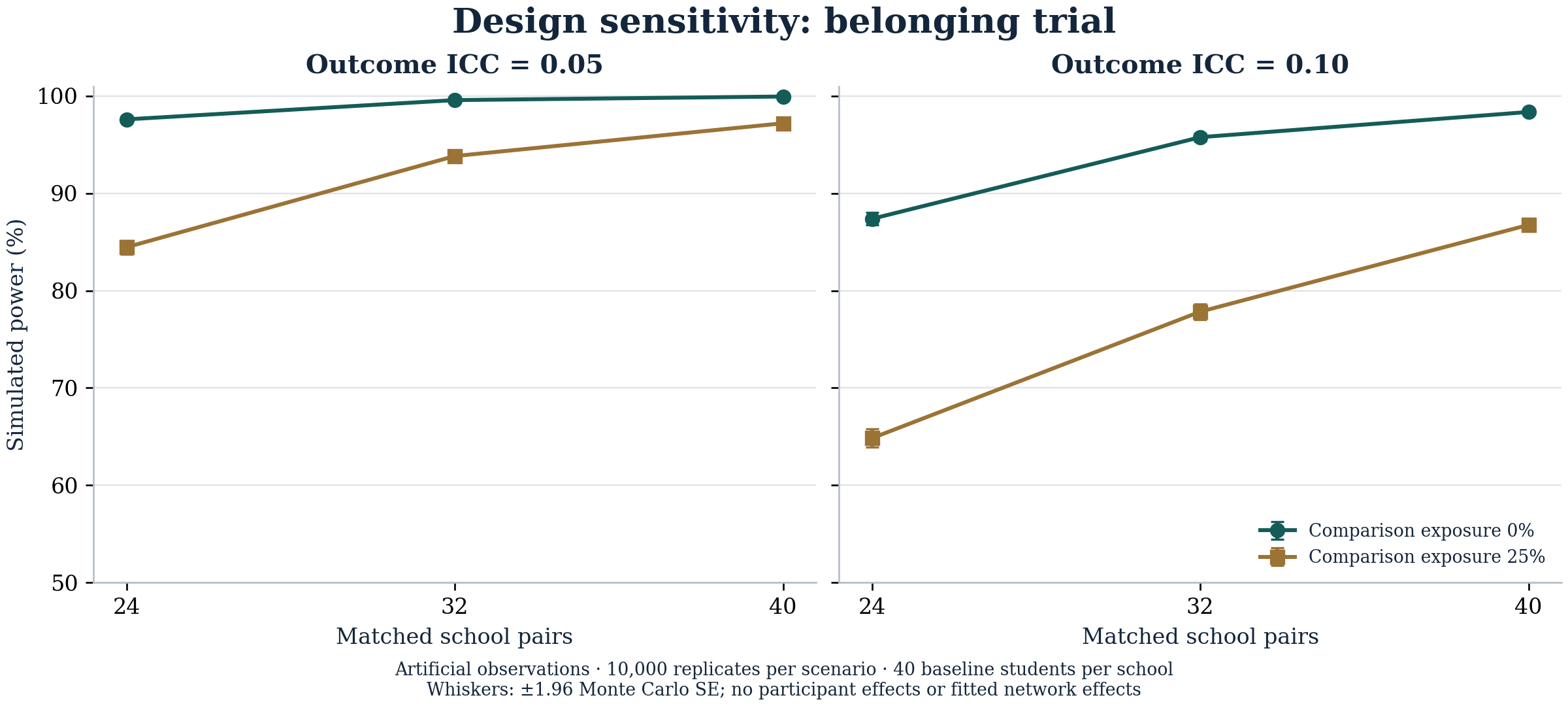
The executed simulation examines 24, 32 and 40 school pairs, outcome intracluster correlations of .05 and .10, and comparison-exposure fractions of zero and .25. Every scenario uses 10,000 artificial replicates and a declared seed. Each school begins with 40 students. A school-specific retention probability is drawn from Beta(6.8, 1.2), followed by a Binomial(40, p) retained count with a lower bound of 12. The achieved mean, variation and observed limits are exported for every scenario; retained cohorts never exceed the baseline 40.
Baseline and endline residual correlations are assumed to be .60 at both school and individual levels. With outcome variance scaled to one, the school-mean change variance is 0.8 times the sum of the ICC and the individual residual fraction divided by retained size. Pair differences combine the two schools’ variances. A .30 baseline-outcome-standard-deviation effect is attenuated to .225 in the .25 comparison-exposure scenario. No additional gain from matching is assumed. The test is a two-sided paired t test at alpha .05 [12].
For the 64-school candidate design, simulated power was 99.58% at ICC .05 without comparison exposure, 93.83% with .25 exposure, 95.77% at ICC .10 without exposure and 77.84% with .25 exposure. Corresponding Monte Carlo standard errors were 0.00065, 0.00241, 0.00201 and 0.00415. The achieved mean retained cohort was approximately 34 with CV approximately .153; observed sizes ranged from 12 to 40. Across these four scenarios the simulated null rejection rates ranged from 4.61% to 5.03%. These are artificial-data operating characteristics of the complete-change estimator, not observed benefits, estimates of real contamination or validation of the proposed imputation model.
The simulation is a planning calculation, not an estimate of how cultural authority will affect real learners. It assumes Gaussian school-mean errors, noninformative retention and no whole-school loss. A scalar attenuation parameter does not reproduce a real network interference process. Bounds, ceiling effects, measurement changes and unequal implementation could produce different power. The evidence supports sensitivity-aware planning, including the need to revise the design before recruitment if plausible assumptions are less favorable.
17. Falsification, burden and consequences
Three patterns would directly challenge the theory. First, increased consultation with no improvement in documented response to challenges would reject the claim that the package produced consequential authority. Second, belonging gains accompanied by poorer transfer would limit its educational rationale. Third, benefits dependent on public cultural disclosure would violate the intervention’s own non-extractive design. The analysis reports these conflicts rather than allowing an appealing average score to settle them.
The protocol collects paid and unpaid staff time, contributor compensation, accessibility expenditures and student-reported pressure. A joint governance and safeguarding group sets feasible stopping thresholds before allocation, informed by the pilot and budget. No invented empirically validated burden threshold is supplied. Unauthorized disclosure or credible retaliation triggers immediate safeguarding review and suspension of the implicated activity; it does not wait for the primary outcome analysis. A refusal to publish material cannot lower a student’s academic grade.
Superintendents receive an implementation account that distinguishes expenditure, decision rights and outcomes. A programme can be infeasible even with a positive point estimate. Conversely, an imprecise result from a small or disrupted trial is not evidence that a community’s concerns are unimportant. The decision to continue must consider the confidence interval, burden, transfer, privacy and the legitimacy of the local governance process.
18. Limitations
The historical CCD frame does not supply a current national recruitment census, individual cultural identity or measures of belonging. Its membership cells involve reporting conventions and potentially unavailable values. The audited releases and selected total restriction must not be generalized to unexamined versions. Recruiting consenting schools able to undertake participatory work may produce a narrower population than the frame suggests, even when randomization is internally sound.
The proposed primary measure requires permission and context-specific testing. A change in respondents’ interpretation of belonging may be part of the intervention and also a threat to longitudinal comparability. Blinding is incomplete, demand effects remain plausible, and the active comparison cannot guarantee identical enthusiasm or facilitator skill. The intervention bundles governance practices, so a positive result cannot identify which component is sufficient or establish a culturally universal programme.
The completed calculations contain artificial outcomes; the administrative audit contains no participant responses. The protocol cannot substitute documentation, code or publication for an ethically conducted trial. No observed treatment effect, accreditation status, external institutional partnership or community endorsement follows from this article. It is a prospective route to primary evidence with completed methodological work, and its most consequential propositions remain open to refutation.
Method and data statement
Source archives were obtained from official NCES addresses and hashed; the public research package includes exact URLs, verification dates, stream-audit code, aggregate diagnostics, study and analysis specifications, original instruments and artificial design results. Raw CCD archives are retained as intermediate source material outside the publication repository. No confidential student records, school recruitment roster, personal narratives or cultural materials are distributed. Public-use administrative access does not authorize collecting or publishing a participant’s own work.
No participants have been enrolled under this protocol, and no registration identifier, ethics approval, acceptance date or new article DOI is asserted. The accompanying tools require NumPy and SciPy for the declared calculations and are tested with synthetic fixtures. They implement no hidden connection to an LMS or student account. Actual study activation requires the finalized measurement pilot, ethics determination, permissions, staffing, budget and prospective registration. Reporting and version control distinguish those future actions from the analyses executed here.
AI, authorship and editorial disclosure
Dr. Freedom Cheteni is the named human author; substantive author approval and independent human editorial assessment of this new protocol remain separate documented actions. The earlier conceptual article is preserved and its review record does not transfer to this new manuscript. The Research University is the publisher; no unnamed Stanford collaborator or alternate journal is presented as an author or accepting venue. Sources retain their original authors, dates, rights and identifiers.
OpenAI’s ChatGPT assisted with source discovery, drafting, code preparation and consistency checking [15]. No model version is invented. Statistical results come from the disclosed executable calculations; AI output is not a participant observation, cultural permission or peer-review decision. A paper companion may retrieve exact passages and explain the protocol’s boundaries. It does not conduct the proposed trial, infer a student’s culture or authorize reuse of a contribution. Human researchers, affected rights-holders and the responsible editorial process retain authority over those decisions.
Reproducibility
Research materials
Inspect the study design, original draft instruments, executed audits, simulations and documented research tools. File labels distinguish proposed procedures from completed analyses.
- Complete research package · ZIP ↗
- Research methods guide ↗
- Prospective study specification ↗
- Instruments and governance charter ↗
- Analysis specification ↗
- Executed CCD feasibility audit ↗
- Artificial design sensitivity results ↗
- Executable research tools · Python ↗
- Source and verification audit ↗
- Methods test results ↗
Warrant and boundaries
Evidence & limits
| Claim | Evidence | Limit |
|---|---|---|
| A historical administrative source can support an inspectable recruitment frame. | Executed CCD directory audit: 102,274 unique school identifiers; 29,115 candidates under declared restrictions. [7][8][9] | Not contemporary eligibility, consent, culture or population representativeness. |
| Membership-cell joins and unavailable counts require explicit restrictions. | Across all 11,209,338 long membership rows, 66,138 counts are blank, including 150 flagged Suppressed. The separate Education Unit Total restriction yields 99,678 unique school totals. [7][8] | No full long-cell duplicate audit; no zero imputation; no inference of individual culture. |
| Cultural authority can be studied as an assigned governance offer. | 64-school/32-pair candidate design with active comparison, bounded decision rights and separate permissions. [2][4][5][6][13] | No enrolled participants; primary instrument rights/pilot and local governance/ethics still required. |
| Design precision depends on retention, clustering and cross-condition exposure. | 12 scenarios with 10,000 artificial replicates each and explicit Monte Carlo error. [11][12][14] | No actual effects; scalar attenuation is not an identified network model or validation of MI. |
References & rights
Reference identity, available full text and access limits are documented by source and verification date. Source checking is distinct from independent quality assessment.
[1]Freedom Cheteni. Beyond Palm Drive: Bringing the Lesson Home. The VR School · Media. 2026-07-21.
Citation only; no source article redistribution or instrument adaptation rights asserted. Original authors and rights-holders retain their rights; source text, figures and copyrighted scale items are not republished.
Inspect authoritative source / evidence ↗[2]Gloria Ladson-Billings. Toward a Theory of Culturally Relevant Pedagogy. American Educational Research Journal, 32(3), 465–491. 1995.
Citation only; no source article redistribution or instrument adaptation rights asserted. Original authors and rights-holders retain their rights; source text, figures and copyrighted scale items are not republished.
Inspect authoritative source / evidence ↗[3]Bryan A. Brown; Kathryn Ribay; Greses Pérez; Phillip A. Boda; Matthew Wilsey. A Virtual Bridge to Cultural Access: Culturally Relevant Virtual Reality and Its Impact on Science Students. International Journal of Technology in Education and Science, 4(2), 86–97. 2020.
Citation only; no source article redistribution or instrument adaptation rights asserted. Original authors and rights-holders retain their rights; source text, figures and copyrighted scale items are not republished.
Inspect authoritative source / evidence ↗[4]Carol Goodenow. The Psychological Sense of School Membership Among Adolescents: Scale Development and Educational Correlates. Psychology in the Schools, 30(1), 79–90. 1993-01.
Citation only; no source article redistribution or instrument adaptation rights asserted. Original authors and rights-holders retain their rights; source text, figures and copyrighted scale items are not republished.
Inspect authoritative source / evidence ↗[5]Stephanie Russo Carroll; Ibrahim Garba; Oscar L. Figueroa-Rodríguez; Jarita Holbrook; Raymond Lovett; Simeon Materechera; Mark Parsons; Kay Raseroka; Desi Rodriguez-Lonebear; Robyn Rowe; Rodrigo Sara; Jennifer D. Walker; Jane Anderson; Maui Hudson. The CARE Principles for Indigenous Data Governance. Data Science Journal, 19, 43. 2020.
Citation only; no source article redistribution or instrument adaptation rights asserted. Original authors and rights-holders retain their rights; source text, figures and copyrighted scale items are not republished.
Inspect authoritative source / evidence ↗[6]Jarg Bergold; Stefan Thomas. Participatory Research Methods: A Methodological Approach in Motion. Forum Qualitative Sozialforschung / Forum: Qualitative Social Research, 13(1), Article 30. 2012.
Citation only; no source article redistribution or instrument adaptation rights asserted. Original authors and rights-holders retain their rights; source text, figures and copyrighted scale items are not republished.
Inspect authoritative source / evidence ↗[7]National Center for Education Statistics. Common Core of Data 2023–24 Public School Universe, version 1a: School Directory and Membership. U.S. Department of Education, NCES. 2024.
Citation only; no source article redistribution or instrument adaptation rights asserted. Original authors and rights-holders retain their rights; source text, figures and copyrighted scale items are not republished.
Inspect authoritative source / evidence ↗[8]National Center for Education Statistics. 2023–24 School Directory and School Membership Companion Files, 2024-252. U.S. Department of Education, NCES. 2024.
Citation only; no source article redistribution or instrument adaptation rights asserted. Original authors and rights-holders retain their rights; source text, figures and copyrighted scale items are not republished.
Inspect authoritative source / evidence ↗[9]National Center for Education Statistics. Common Core of Data: ED Public Data Frequently Asked Questions. U.S. Department of Education, NCES. Accessed 2026-10-16.
Citation only; no source article redistribution or instrument adaptation rights asserted. Original authors and rights-holders retain their rights; source text, figures and copyrighted scale items are not republished.
Inspect authoritative source / evidence ↗[10]Fang Fang Chen. Sensitivity of Goodness of Fit Indexes to Lack of Measurement Invariance. Structural Equation Modeling: A Multidisciplinary Journal, 14(3), 464–504. 2007-07-31.
Citation only; no source article redistribution or instrument adaptation rights asserted. Original authors and rights-holders retain their rights; source text, figures and copyrighted scale items are not republished.
Inspect authoritative source / evidence ↗[11]Michael G. Hudgens; M. Elizabeth Halloran. Toward Causal Inference With Interference. Journal of the American Statistical Association, 103(482), 832–842. 2008-06.
Citation only; no source article redistribution or instrument adaptation rights asserted. Original authors and rights-holders retain their rights; source text, figures and copyrighted scale items are not republished.
Inspect authoritative source / evidence ↗[12]Clare Rutterford; Andrew Copas; Sandra Eldridge. Methods for Sample Size Determination in Cluster Randomized Trials. International Journal of Epidemiology, 44(3), 1051–1067. 2015-06.
Citation only; no source article redistribution or instrument adaptation rights asserted. Original authors and rights-holders retain their rights; source text, figures and copyrighted scale items are not republished.
Inspect authoritative source / evidence ↗[13]Marion K. Campbell; Gilda Piaggio; Diana R. Elbourne; Douglas G. Altman; for the CONSORT Group. CONSORT 2010 Statement: Extension to Cluster Randomised Trials. BMJ, 345, e5661. 2012-09-04.
Citation only; no source article redistribution or instrument adaptation rights asserted. Original authors and rights-holders retain their rights; source text, figures and copyrighted scale items are not republished.
Inspect authoritative source / evidence ↗[14]John Barnard; Donald B. Rubin. Small-Sample Degrees of Freedom with Multiple Imputation. Biometrika, 86(4), 948–955. 1999-12.
Citation only; no source article redistribution or instrument adaptation rights asserted. Original authors and rights-holders retain their rights; source text, figures and copyrighted scale items are not republished.
Inspect authoritative source / evidence ↗[15]OpenAI. ChatGPT [AI-assisted drafting software]. Software/tool disclosure, not a human author or reviewer. Accessed 2026-10-16.
Citation only; no source article redistribution or instrument adaptation rights asserted. Original authors and rights-holders retain their rights; source text, figures and copyrighted scale items are not republished.
Inspect authoritative source / evidence ↗
Original primary-study protocol and executed public-data methods; cited authors retain attribution. Administrative categories do not authorize cultural representation or personal disclosure. No source findings are reassigned to the named human author.